반응형

wxWidgets을 빌드하고 간단한 예제를 만들어 보자.


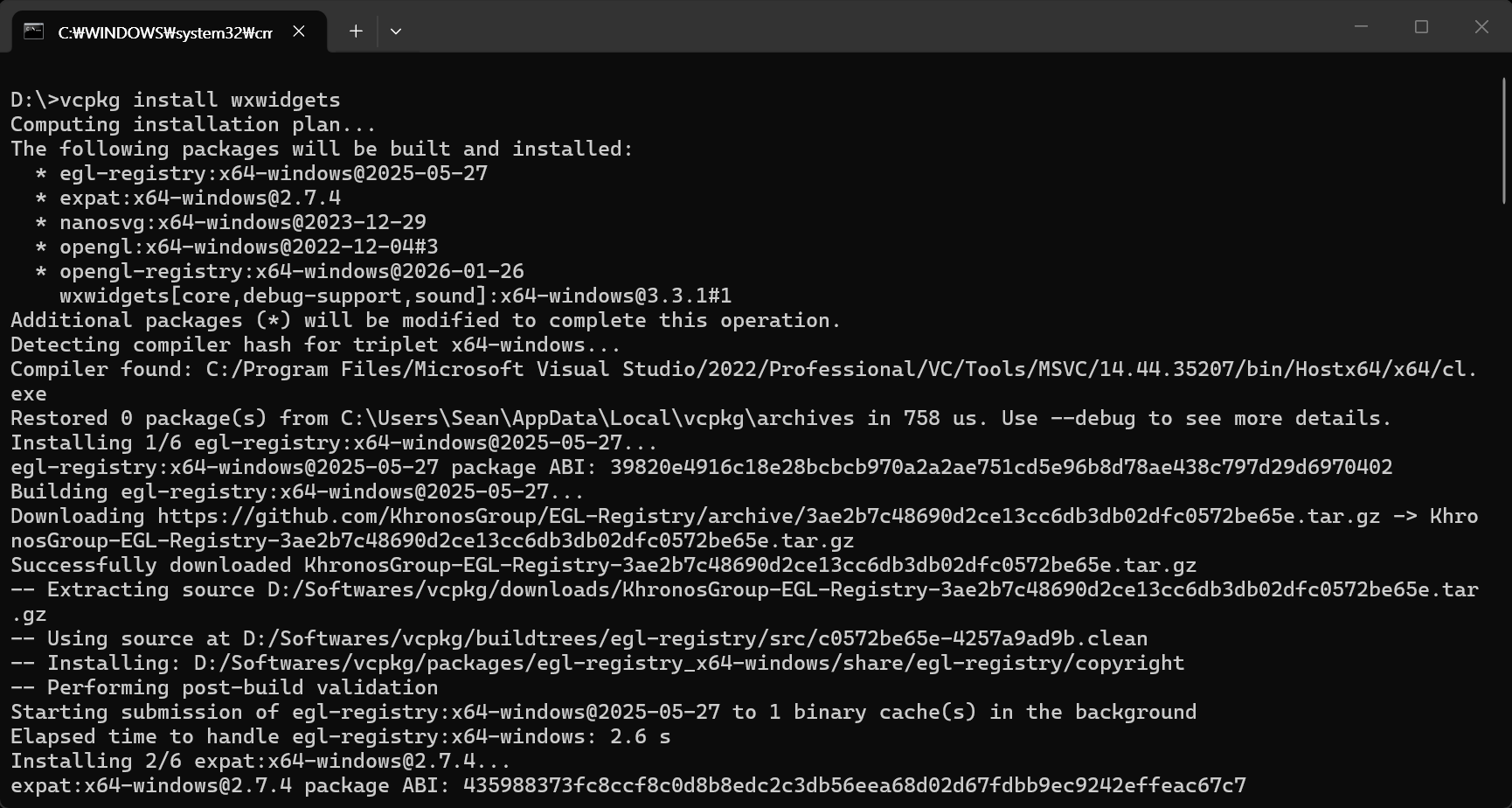
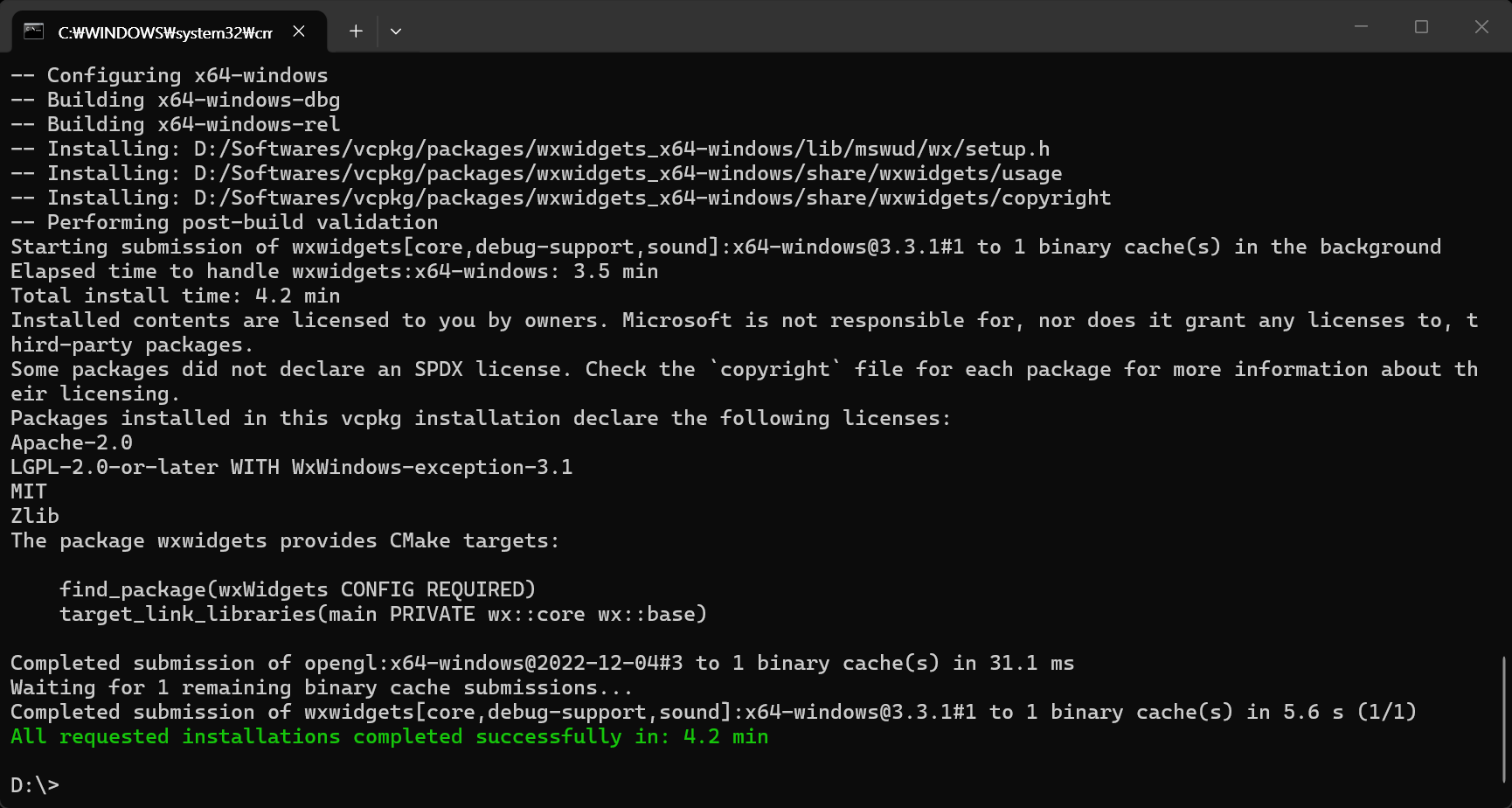
vcpkg install wxwidgets


약 4분 정도가 걸린다.


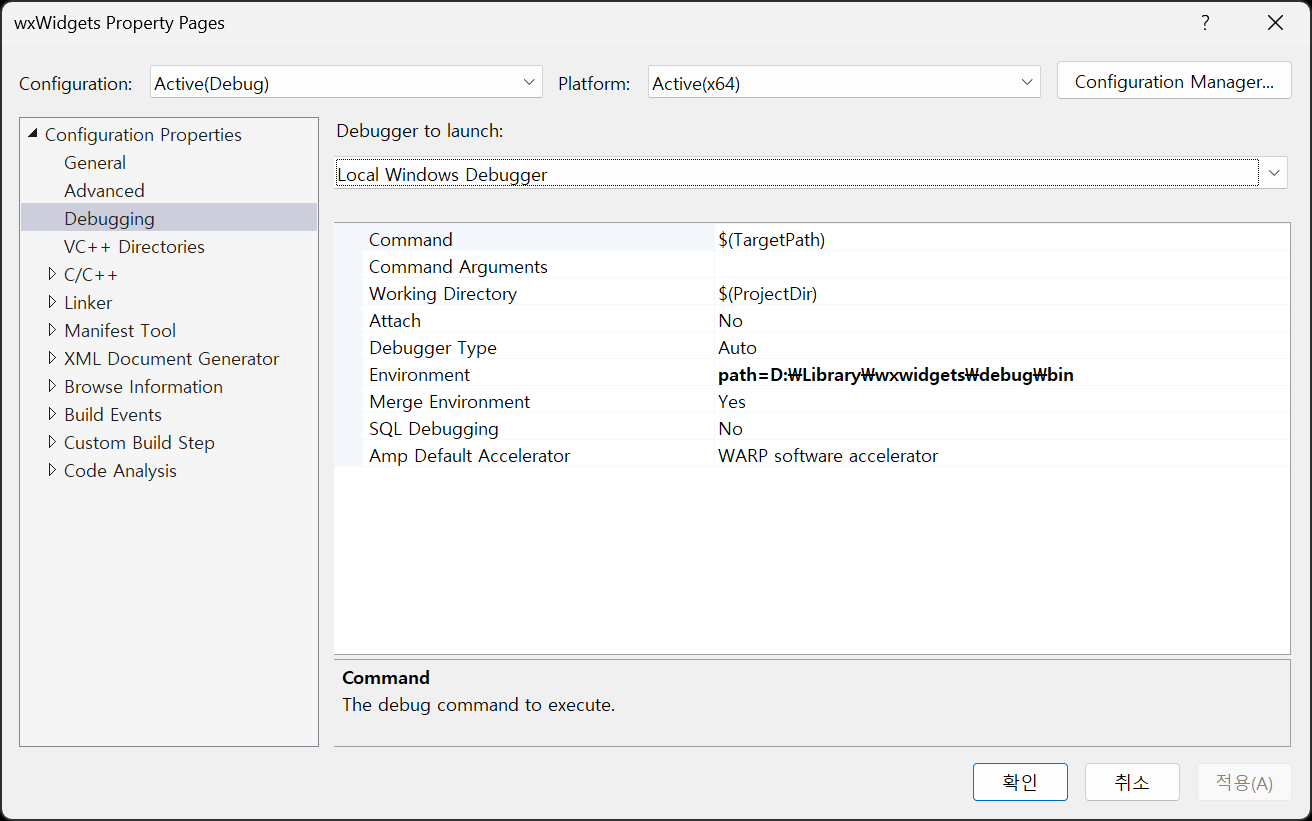
콘솔 프로젝트라면 SubSystem을 Windows로 바꿔준다.


간단한 예제.

#include <wx/wx.h>

class MyApp : public wxApp
{
public:
	bool OnInit() override;
};

wxIMPLEMENT_APP(MyApp);

class MyFrame : public wxFrame
{
public:
	MyFrame();

private:
	void OnHello(wxCommandEvent& event);
	void OnExit(wxCommandEvent& event);
	void OnAbout(wxCommandEvent& event);
};

enum
{
	ID_Hello = 1
};

bool MyApp::OnInit()
{
	MyFrame* frame = new MyFrame();
	frame->Show(true);
	return true;
}

MyFrame::MyFrame() : wxFrame(nullptr, wxID_ANY, "Hello World")
{
	wxMenu* menuFile = new wxMenu;
	menuFile->Append(ID_Hello, "&Hello...\tCtrl-H", "Help string shown in status bar for this menu item");
	menuFile->AppendSeparator();
	menuFile->Append(wxID_EXIT);

	wxMenu* menuHelp = new wxMenu;
	menuHelp->Append(wxID_ABOUT);

	wxMenuBar* menuBar = new wxMenuBar;
	menuBar->Append(menuFile, "&File");
	menuBar->Append(menuHelp, "&Help");

	SetMenuBar(menuBar);

	CreateStatusBar();
	SetStatusText("Welcome to wxWidgets!");

	Bind(wxEVT_MENU, &MyFrame::OnHello, this, ID_Hello);
	Bind(wxEVT_MENU, &MyFrame::OnAbout, this, wxID_ABOUT);
	Bind(wxEVT_MENU, &MyFrame::OnExit, this, wxID_EXIT);
}

void MyFrame::OnExit(wxCommandEvent& event)
{
	Close(true);
}

void MyFrame::OnAbout(wxCommandEvent& event)
{
	wxMessageBox("This is a wxWidgets Hello World example", "About Hello World", wxOK | wxICON_INFORMATION);
}

void MyFrame::OnHello(wxCommandEvent& event)
{
	wxLogMessage("Hello world from wxWidgets!");
}
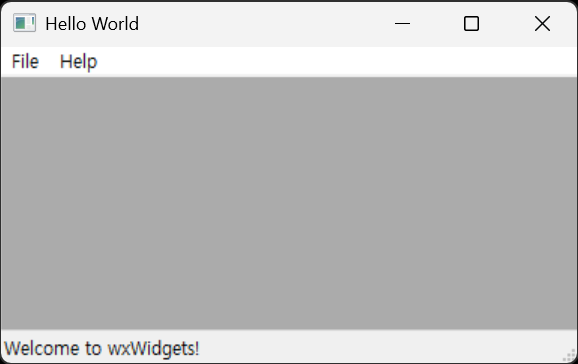


버튼을 추가해 보자.

.
.
.
	CreateStatusBar();
	SetStatusText("Welcome to wxWidgets!");

	wxPanel* panel = new wxPanel(this, wxID_ANY);
	wxButton* myButton = new wxButton(panel, wxID_ANY, "Press Me", wxPoint(30, 30), wxSize(100, 30));
	myButton->Bind(wxEVT_BUTTON, &MyFrame::OnHello, this);
	//Bind(wxEVT_BUTTON, &MyFrame::OnHello, this, myButton->GetId());

	Bind(wxEVT_MENU, &MyFrame::OnHello, this, ID_Hello);
	Bind(wxEVT_MENU, &MyFrame::OnAbout, this, wxID_ABOUT);
	Bind(wxEVT_MENU, &MyFrame::OnExit, this, wxID_EXIT);
.
.
.
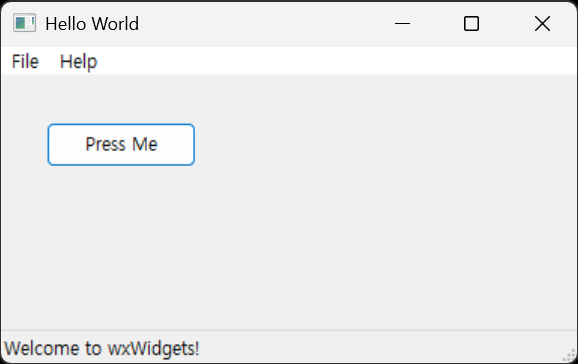


코드만으로 UI를 디자인하기는 쉽지 않다. 필요하다면 wysiwyg 방식으로 디자인할 수 있는 wxFormBuilder를 사용하자.

wxFormBuilder


이번에는 OpenCV를 이용해 이미지를 표시해 보자.

#include <wx/wx.h>
#include <opencv2/opencv.hpp>

class MyApp : public wxApp
{
public:
	bool OnInit() override;
};

wxIMPLEMENT_APP(MyApp);

class MyFrame : public wxFrame
{
public:
	MyFrame();

private:
	void OnHello(wxCommandEvent& event);
	void OnExit(wxCommandEvent& event);
	void OnAbout(wxCommandEvent& event);

	wxPanel* m_panel; // 버튼과 이미지를 담을 패널
	wxStaticBitmap* m_imageCtrl; // 이미지 표시를 위한 컨트롤
};

enum
{
	ID_Hello = 1
};

bool MyApp::OnInit()
{
	MyFrame* frame = new MyFrame();
	frame->Show(true);
	return true;
}

MyFrame::MyFrame() : wxFrame(nullptr, wxID_ANY, "Hello World")
{
	wxMenu* menuFile = new wxMenu;
	menuFile->Append(ID_Hello, "&Hello...\tCtrl-H", "Help string shown in status bar for this menu item");
	menuFile->AppendSeparator();
	menuFile->Append(wxID_EXIT);

	wxMenu* menuHelp = new wxMenu;
	menuHelp->Append(wxID_ABOUT);

	wxMenuBar* menuBar = new wxMenuBar;
	menuBar->Append(menuFile, "&File");
	menuBar->Append(menuHelp, "&Help");

	SetMenuBar(menuBar);

	CreateStatusBar();
	SetStatusText("Welcome to wxWidgets!");

	m_panel = new wxPanel(this, wxID_ANY);
	wxButton* myButton = new wxButton(m_panel, wxID_ANY, "Press Me", wxPoint(30, 30), wxSize(100, 30));
	myButton->Bind(wxEVT_BUTTON, &MyFrame::OnHello, this);
	//Bind(wxEVT_BUTTON, &MyFrame::OnHello, this, myButton->GetId());

	m_imageCtrl = new wxStaticBitmap(m_panel, wxID_ANY, wxNullBitmap, wxPoint(30, 80));
	// 이미지 표시 컨트롤 초기화. wxNullBitmap으로 초기화하여 나중에 이미지가 로드될 때 업데이트할 수 있도록 함.

	Bind(wxEVT_MENU, &MyFrame::OnHello, this, ID_Hello);
	Bind(wxEVT_MENU, &MyFrame::OnAbout, this, wxID_ABOUT);
	Bind(wxEVT_MENU, &MyFrame::OnExit, this, wxID_EXIT);
}

void MyFrame::OnExit(wxCommandEvent& event)
{
	Close(true);
}

void MyFrame::OnAbout(wxCommandEvent& event)
{
	wxMessageBox("This is a wxWidgets Hello World example", "About Hello World", wxOK | wxICON_INFORMATION);
}

void MyFrame::OnHello(wxCommandEvent& event)
{
	//wxLogMessage("Hello world from wxWidgets!");
	cv::Mat image = cv::imread("palvin1.png");
	if (image.empty())
	{
		wxLogError("Could not load image!");
	}
	else
	{
		// OpenCV는 BGR을 사용하므로 wxImage에서 필요로 하는 RGB 형식으로 변환.
		cv::cvtColor(image, image, cv::COLOR_BGR2RGB);

		// wxWidgets 구조상 플랫폼 비의존적(Device Independent)인 픽셀 데이터를 플랫폼 의존적(Device Dependent)인
		// 이미지로 그리기 위해서는 wxImage를 거쳐 wxBitmap으로 변환해야 한다. wxImage는 픽셀 데이터를 소유하므로
		// 이미지가 wxImage에 의해 관리되도록 true를 전달한다.
		wxImage wxImg(image.cols, image.rows, image.data, true);
		wxBitmap bitmap(wxImg);

		if (m_imageCtrl)
		{
			m_imageCtrl->SetBitmap(bitmap);
			m_imageCtrl->SetSize(bitmap.GetWidth(), bitmap.GetHeight());
			m_panel->Refresh();
		}
	}
}


wxStaticBitmap과 같은 컨트롤을 거치지 않고 wxPaintDC(Device Context)를 이용하여 디스플레이에 직접 그리는 방식도 가능하다. 이 방법은 비디오 캡처 등으로 계속 프레임이 바뀔 때 컨트롤을 계속 업데이트하는 오버헤드를 줄이는데 유리할 수 있다.


#include <wx/wx.h>
//#include <wx/dcbuffer.h> // wxBufferedPaintDC를 사용하기 위한 헤더
#include <opencv2/opencv.hpp>

class MyApp : public wxApp
{
public:
	bool OnInit() override;
};

wxIMPLEMENT_APP(MyApp);

class MyFrame : public wxFrame
{
public:
	MyFrame();

private:
	void OnHello(wxCommandEvent& event);
	void OnExit(wxCommandEvent& event);
	void OnAbout(wxCommandEvent& event);
	void OnPaint(wxPaintEvent& event);

	wxPanel* m_panel; // 버튼과 이미지를 담을 패널
	wxBitmap m_bitmap; // 직접 그릴 비트맵 데이터
};

enum
{
	ID_Hello = 1
};

bool MyApp::OnInit()
{
	MyFrame* frame = new MyFrame();
	frame->Show(true);
	return true;
}

MyFrame::MyFrame() : wxFrame(nullptr, wxID_ANY, "Hello World")
{
	wxMenu* menuFile = new wxMenu;
	menuFile->Append(ID_Hello, "&Hello...\tCtrl-H", "Help string shown in status bar for this menu item");
	menuFile->AppendSeparator();
	menuFile->Append(wxID_EXIT);

	wxMenu* menuHelp = new wxMenu;
	menuHelp->Append(wxID_ABOUT);

	wxMenuBar* menuBar = new wxMenuBar;
	menuBar->Append(menuFile, "&File");
	menuBar->Append(menuHelp, "&Help");

	SetMenuBar(menuBar);

	CreateStatusBar();
	SetStatusText("Welcome to wxWidgets!");

	m_panel = new wxPanel(this, wxID_ANY);
	//m_panel->SetBackgroundStyle(wxBG_STYLE_PAINT);
	// wxBufferedPaintDC 사용시 검은 화면 방지, wxBG_STYLE_PAINT는 직접 패널 배경을 그리겠다는 의미로
	// OnPaint에서 DC의 배경색으로 패널의 배경색을 설정하고 Clear()를 호출하여 화면을 지워야 한다.

	wxButton* myButton = new wxButton(m_panel, wxID_ANY, "Press Me", wxPoint(30, 30), wxSize(100, 30));
	myButton->Bind(wxEVT_BUTTON, &MyFrame::OnHello, this);
	//Bind(wxEVT_BUTTON, &MyFrame::OnHello, this, myButton->GetId());

	// 패널에 페인트 이벤트를 바인드하여 DC를 통해 직접 그린다.
	m_panel->Bind(wxEVT_PAINT, &MyFrame::OnPaint, this);
	m_panel->Bind(wxEVT_ERASE_BACKGROUND, [](wxEraseEvent& event) { event.Skip(); }); // 배경 지우기 이벤트를 무시하여 깜빡임 방지
	m_panel->SetDoubleBuffered(true); // 깜빡임 방지 위해 더블 버퍼링 활성화

	Bind(wxEVT_MENU, &MyFrame::OnHello, this, ID_Hello);
	Bind(wxEVT_MENU, &MyFrame::OnAbout, this, wxID_ABOUT);
	Bind(wxEVT_MENU, &MyFrame::OnExit, this, wxID_EXIT);
}

void MyFrame::OnExit(wxCommandEvent& event)
{
	Close(true);
}

void MyFrame::OnAbout(wxCommandEvent& event)
{
	wxMessageBox("This is a wxWidgets Hello World example", "About Hello World", wxOK | wxICON_INFORMATION);
}

void MyFrame::OnHello(wxCommandEvent& event)
{
	//wxLogMessage("Hello world from wxWidgets!");
	cv::Mat image = cv::imread("palvin1.png");
	if (image.empty())
	{
		wxLogError("Could not load image!");
	}
	else
	{
		// OpenCV는 BGR을 사용하므로 wxImage에서 필요로 하는 RGB 형식으로 변환.
		cv::cvtColor(image, image, cv::COLOR_BGR2RGB);

		// wxWidgets 구조상 플랫폼 비의존적(Device Independent)인 픽셀 데이터를 플랫폼 의존적(Device Dependent)인
		// 이미지로 그리기 위해서는 wxImage를 거쳐 wxBitmap으로 변환해야 한다. wxImage는 픽셀 데이터를 소유하므로
		// 이미지가 wxImage에 의해 관리되도록 true를 전달한다.
		wxImage wxImg(image.cols, image.rows, image.data, true);
		m_bitmap = wxBitmap(wxImg);

		m_panel->Refresh(); // 패널을 다시 그리도록 요청하여 OnPaint가 호출되게 한다.
	}
}

void MyFrame::OnPaint(wxPaintEvent& event)
{
	// m_panel에 대한 Paint DC 생성 (페인트 이벤트 안에서만 사용 가능)
	wxPaintDC dc(m_panel);

	// wxPaintDC 대신 메모리에 먼저 그리고 화면에 출력하는 wxBufferedPaintDC 클래스를 사용해도 부드러운 출력이
	// 가능하며 깜빡임도 줄일 수 있다고 한다. wxBufferedPaintDC는 wxPaintDC를 상속하므로 wxPaintDC 대신
	// wxBufferedPaintDC를 사용하면 된다. 이 경우 m_panel에 더블 버퍼링은 활성화할 필요가 없다.
	// 둘 중 하나만 사용하면 된다. wxPaintDC + SetDoubleBuffered 사용을 추천.
	// wxBufferedPaintDC는 운영체제의 네이티브 더블 버퍼링을 지원하지 않는 옛날 OS나 특수한 상황을 위해 존재한다.

	// 상단의 #include <wx/dcbuffer.h> 주석 취소.
	//wxBufferedPaintDC dc(m_panel);

	//dc.SetBackground(wxBrush(m_panel->GetBackgroundColour()));
	//dc.Clear();
	// 패널 기본 배경색으로 화면을 지워준다.
	// wxBG_STYLE_PAINT 스타일을 사용했다면 OnPaint에서 DC의 배경색을 패널의 배경색으로 설정하고 Clear()를 호출하여 화면을
	// 지워야 검은색으로 나타나지 않는다.

	if (m_bitmap.IsOk()) // 비트맵이 유효한 경우에만 그린다.
	{
		// 지정된 좌표 (30, 80)에 비트맵을 직접 그린다. 마스크 사용은 false로 설정.
		dc.DrawBitmap(m_bitmap, 30, 80, false);
	}
}


결과는 이전 코드와 같다.


※ 참고

Hello World Example

Documentation

Tutorials


반응형
Posted by J-sean
:

보호되어 있는 글입니다.
내용을 보시려면 비밀번호를 입력하세요.

반응형

GDI Plus Bitmap을 OpenCV Mat으로, 다시 OpenCV Mat을 GDI Plus Bitmap으로 변환해 보자.


1
2
3
4
5
6
7
8
9
10
11
12
13
14
15
16
17
18
19
20
21
22
23
24
25
26
27
28
29
30
31
32
33
34
35
36
37
38
39
40
41
42
43
44
45
46
47
48
49
50
51
52
53
54
55
56
57
58
59
60
61
62
63
64
65
66
67
68
69
70
71
72
73
74
75
76
77
78
79
80
81
82
83
84
85
86
87
88
89
90
91
92
93
94
95
96
97
98
99
100
101
102
103
104
105
106
107
108
109
110
111
112
113
114
115
116
117
118
119
120
121
#include <windows.h>
#include <gdiplus.h>
#include <opencv2/opencv.hpp>
 
#pragma comment(lib, "gdiplus")
 
using namespace cv;
using namespace Gdiplus;
 
LRESULT CALLBACK WndProc(HWND, UINT, WPARAM, LPARAM);
HINSTANCE g_hInst;
LPCSTR lpszClass = "Mat and Bitmap";
 
Mat originalImage;
Mat bitmapToMat;
 
int APIENTRY WinMain(HINSTANCE hInstance, HINSTANCE hPrevInstance, LPSTR lpszCmdParam, int nCmdShow)
{
    HWND hWnd;
    MSG Message;
    WNDCLASS WndClass;
    g_hInst = hInstance;
 
    ULONG_PTR gpToken;
    GdiplusStartupInput gpsi;
    if (GdiplusStartup(&gpToken, &gpsi, NULL!= Ok) {
        MessageBox(NULL, TEXT("GDI+ start-up error."), TEXT("GDI+ Error"), MB_OK);
 
        return 0;
    }
 
    WndClass.cbClsExtra = 0;
    WndClass.cbWndExtra = 0;
    WndClass.hbrBackground = (HBRUSH)(COLOR_BTNFACE + 1); //(HBRUSH)GetStockObject(WHITE_BRUSH);
    WndClass.hCursor = LoadCursor(NULL, IDC_ARROW);
    WndClass.hIcon = LoadIcon(NULL, IDI_APPLICATION);
    WndClass.hInstance = hInstance;
    WndClass.lpfnWndProc = (WNDPROC)WndProc;
    WndClass.lpszClassName = lpszClass;
    WndClass.lpszMenuName = NULL;
    WndClass.style = CS_HREDRAW | CS_VREDRAW;
    RegisterClass(&WndClass);
 
    hWnd = CreateWindow(lpszClass, lpszClass, WS_OVERLAPPEDWINDOW, CW_USEDEFAULT, CW_USEDEFAULT,
        630960NULL, (HMENU)NULL, hInstance, NULL);
    ShowWindow(hWnd, nCmdShow);
 
    while (GetMessage(&Message, 000)) {
        TranslateMessage(&Message);
        DispatchMessage(&Message);
    }
 
    GdiplusShutdown(gpToken);
 
    return (int)Message.wParam;
}
 
Mat BitmapToMat(Bitmap* bitmap)
{
    PixelFormat pixelFormat = bitmap->GetPixelFormat();
    if (pixelFormat != PixelFormat32bppARGB) // PixelFormat24bppRGB
        return Mat();
 
    int width = bitmap->GetWidth();
    int height = bitmap->GetHeight();
    Gdiplus::Rect rectLock(00, width, height);
    Gdiplus::BitmapData bitmapData;
 
    if (bitmap->LockBits(&rectLock, Gdiplus::ImageLockModeRead, pixelFormat, &bitmapData) != Gdiplus::Ok)
        return Mat();
 
    Mat mat = Mat(height, width, CV_8UC4, // CV_8UC3
        static_cast<unsigned char*>(bitmapData.Scan0), bitmapData.Stride).clone();
 
    bitmap->UnlockBits(&bitmapData);
 
    return mat;
}
 
void OnPaint(HDC hdc)
{
    Graphics G(hdc);
 
    // Mat to Bitmap
    cvtColor(originalImage, originalImage, COLOR_BGR2BGRA);
    Bitmap bitmap((INT)originalImage.size().width, (INT)originalImage.size().height, (INT)originalImage.step,
        PixelFormat32bppARGB, originalImage.data);
    G.DrawImage(&bitmap, 00, bitmap.GetWidth(), bitmap.GetHeight());
 
    // Bitmap to Mat
    bitmapToMat = BitmapToMat(&bitmap);
 
    imshow("BitmapToMat", bitmapToMat);
}
 
LRESULT CALLBACK WndProc(HWND hWnd, UINT iMessage, WPARAM wParam, LPARAM lParam)
{
    HDC hdc;
    PAINTSTRUCT ps;
 
    switch (iMessage) {
    case WM_CREATE:
        originalImage = imread("Barbara.jpg");
 
        return 0;
 
    case WM_PAINT:
        hdc = BeginPaint(hWnd, &ps);
        OnPaint(hdc);
        EndPaint(hWnd, &ps);
 
        return 0;
 
    case WM_DESTROY:
        PostQuitMessage(0);
 
        return 0;
    }
 
    return(DefWindowProc(hWnd, iMessage, wParam, lParam));
}


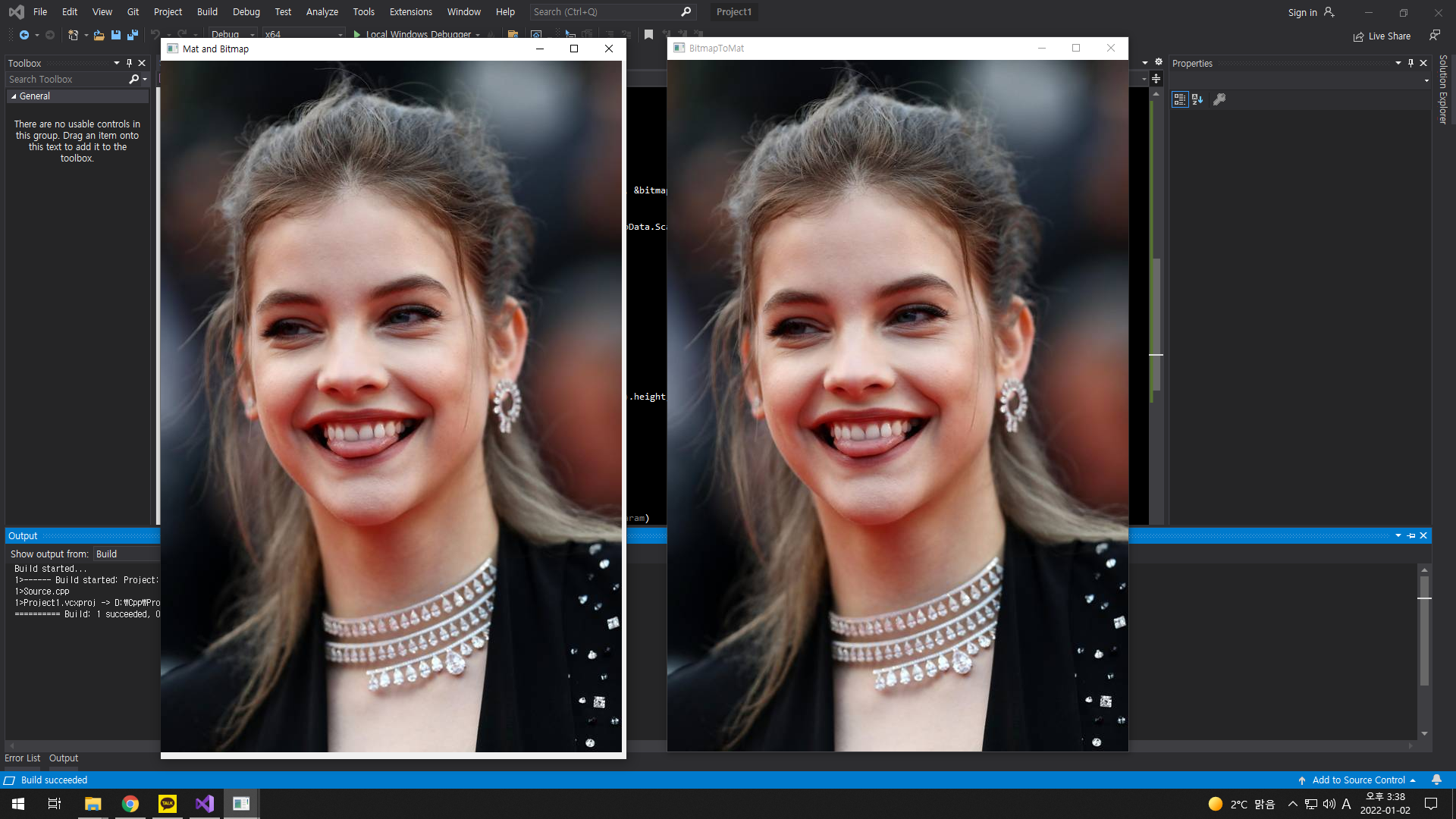
소스를 입력하고 빌드한다.


실행하면 Bitmap과 Mat 포맷의 이미지가 출력된다.


Mat to Bitmap 주석 부분이 Mat에서 Bitmap으로 변환의 핵심이다.


위 함수가 Bitmap에서 Mat으로 변환의 핵심이다.


반응형

'Computer Vision' 카테고리의 다른 글

OpenCV with Qt for Python(PyQt)  (0) 2025.02.09
Compiling and Running OpenPose from Source  (2) 2022.05.15
OpenCV with C# and Camera  (0) 2021.12.29
OpenCvSharp for Network  (0) 2021.12.28
OpenCV with C#  (0) 2021.11.20
Posted by J-sean
:
반응형

TcpListener, TcpClient, NetworkStream, MemoryStream등을 이용해 클라이언트의 화면을 서버로 전송하는 프로그램을 만들어 보자. (이 예제는 thread를 사용하지 않기 때문에 상황에 따라 프로그램이 freeze될 수 있다)


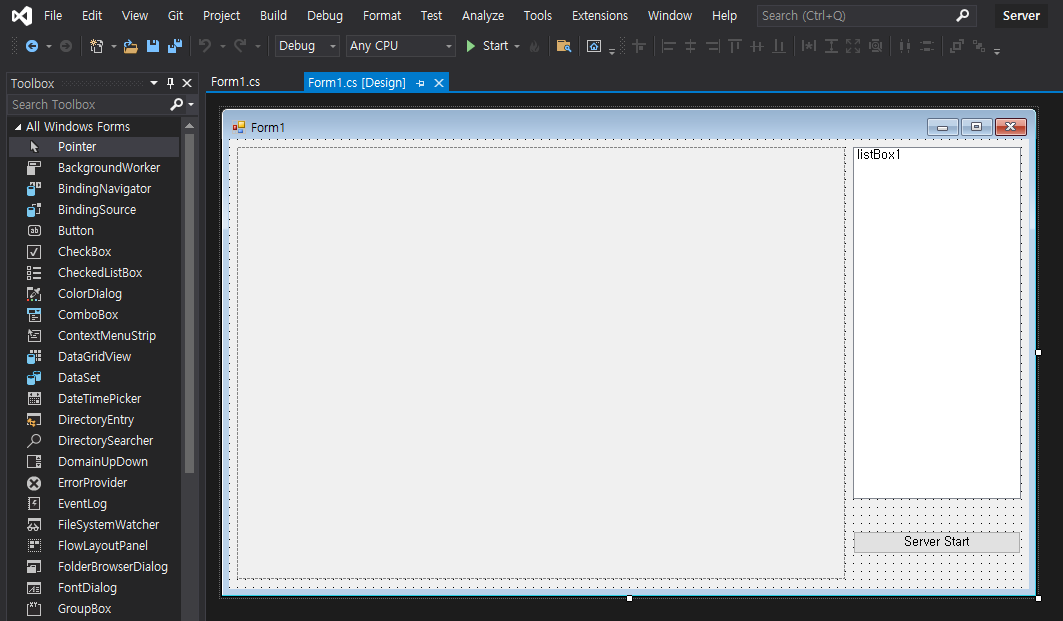
서버 폼에 PictureBox, ListBlox, Button을 적당히 배치한다.


1
2
3
4
5
6
7
8
9
10
11
12
13
14
15
16
17
18
19
20
21
22
23
24
25
26
27
28
29
30
31
32
33
34
35
36
37
38
39
40
41
42
43
44
45
46
47
48
49
50
51
52
53
54
55
56
57
58
59
60
61
62
63
64
65
66
67
68
69
70
71
72
73
74
75
76
77
78
79
80
81
82
83
84
85
86
87
88
89
90
91
92
93
94
95
96
97
98
using System;
using System.Collections.Generic;
using System.ComponentModel;
using System.Data;
using System.Drawing;
using System.Linq;
using System.Text;
using System.Threading.Tasks;
using System.Windows.Forms;
 
using System.Net;
using System.Net.Sockets;
using System.IO;
 
namespace Server
{
    public partial class Form1 : Form
    {
        TcpListener listener;
        TcpClient client;
        NetworkStream networkStream;
        MemoryStream memoryStream;
        Bitmap bitmap;
        IPHostEntry ipHostEntry;
 
        string serverIP;
        int serverPort;
        byte[] data = new byte[1048576]; // 1MB
        byte[] dataSizeFromClient;
        int receivedDataSize;
        int expectedDataSize;
 
        public Form1()
        {
            InitializeComponent();
 
            pictureBox1.SizeMode = PictureBoxSizeMode.StretchImage;
 
            serverPort = 7000;
            // 호스트 이름으로 검색되는 첫 번째 IP4 주소 확인
            string hostName = Dns.GetHostName();
            ipHostEntry = Dns.GetHostEntry(hostName);
            foreach (IPAddress address in ipHostEntry.AddressList)
            {
                if (address.AddressFamily == AddressFamily.InterNetwork)
                {
                    serverIP = address.ToString();
                    break;
                }
            }
            listBox1.Items.Add("Server IP: " + serverIP);
 
            listener = new TcpListener(IPAddress.Any, serverPort);
            //listener = new TcpListener(IPAddress.Parse("127.0.0.1"), serverPort);            
        }
 
        private void button1_Click(object sender, EventArgs e)
        {
            listener.Start();
 
            client = listener.AcceptTcpClient();
            listBox1.Items.Add("Client IP: " + client.Client.RemoteEndPoint.ToString().Split(':')[0]);
 
            networkStream = client.GetStream();
 
            receivedDataSize = 0;
            dataSizeFromClient = new byte[sizeof(int)];
 
            if (networkStream.CanRead)
            {
                // 클라이언트로 부터 받아야 할 데이터 사이즈 정보 확인.
                networkStream.Read(dataSizeFromClient, 0, dataSizeFromClient.Length);
                expectedDataSize = BitConverter.ToInt32(dataSizeFromClient, 0);
                listBox1.Items.Add("Expected data size: " + (expectedDataSize / 1024).ToString() + "KB");
 
                // 데이터 송신
                do
                {
                    receivedDataSize += networkStream.Read(data, receivedDataSize, data.Length - receivedDataSize);
                    // Reads data from the NetworkStream and stores it to a byte array.                    
                } while (networkStream.DataAvailable);
                // while (expectedDataSize > receivedDataSize);
            }
 
            listBox1.Items.Add("Data received: " + (receivedDataSize / 1024).ToString() + "KB");
            memoryStream = new MemoryStream(data, 0, receivedDataSize);
            // Initializes a new non-resizable instance of the MemoryStream class
            // based on the specified region (index) of a byte array.            
            bitmap = new Bitmap(memoryStream);
            pictureBox1.Image = bitmap;
 
            listener.Stop();
            client.Close();
            networkStream.Close();
            memoryStream.Close();
        }
    }
}


서버 소스를 입력하고 빌드한다.


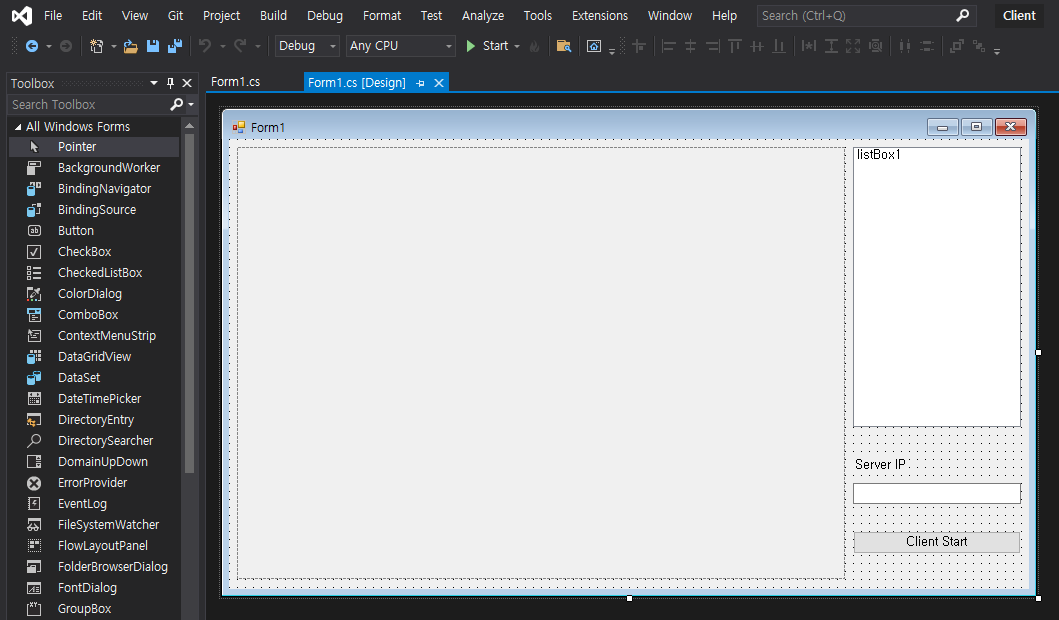
클라이언트 폼에 PictureBox, ListBox, Label, TextBox, Button을 적당히 배치한다.


1
2
3
4
5
6
7
8
9
10
11
12
13
14
15
16
17
18
19
20
21
22
23
24
25
26
27
28
29
30
31
32
33
34
35
36
37
38
39
40
41
42
43
44
45
46
47
48
49
50
51
52
53
54
55
56
57
58
59
60
61
62
63
64
65
66
67
68
69
70
71
72
73
74
75
76
77
78
using System;
using System.Collections.Generic;
using System.ComponentModel;
using System.Data;
using System.Drawing;
using System.Linq;
using System.Text;
using System.Threading.Tasks;
using System.Windows.Forms;
 
using System.Net;
using System.Net.Sockets;
using System.IO;
 
namespace Client
{
    public partial class Form1 : Form
    {
        TcpClient client;
        NetworkStream networkStream;
        MemoryStream memoryStream;
        Bitmap screen;
 
        string serverIP;
        int serverPort;
        byte[] data;
        byte[] dataSizeForServer;
 
        public Form1()
        {
            InitializeComponent();
 
            pictureBox1.SizeMode = PictureBoxSizeMode.StretchImage;
            textBox1.Text = "192.168.0.100";
        }
 
        private void button1_Click(object sender, EventArgs e)
        {
            memoryStream = new MemoryStream();
            screen = GetScreen();
            pictureBox1.Image = screen;
            screen.Save(memoryStream, System.Drawing.Imaging.ImageFormat.Png);
            data = memoryStream.ToArray();
 
            serverIP = textBox1.Text;
            serverPort = 7000;
            client = new TcpClient(serverIP, serverPort);
            listBox1.Items.Add("Connected to: " + client.Client.RemoteEndPoint.ToString().Split(':')[0]);
 
            networkStream = client.GetStream();
 
            if (networkStream.CanWrite)
            {
                // 보낼 데이터 사이즈를 서버에 미리 공유
                dataSizeForServer = BitConverter.GetBytes(data.Length);
                networkStream.Write(dataSizeForServer, 0, dataSizeForServer.Length);
 
                // 데이터 전송
                networkStream.Write(data, 0, data.Length);
                listBox1.Items.Add("Data sent: " + (data.Length / 1024).ToString() + "KB");
            }
 
            client.Close();
            networkStream.Close();
            memoryStream.Close();
        }
 
        private Bitmap GetScreen()
        {
            Bitmap bitmap = new Bitmap(Screen.PrimaryScreen.Bounds.Width, Screen.PrimaryScreen.Bounds.Height);
            Graphics g = Graphics.FromImage(bitmap);
            g.CopyFromScreen(0000, bitmap.Size);
            g.Dispose();
 
            return bitmap;
        }
    }
}


클라이언트 소스를 입력하고 빌드한다.


서버를 실행하면 IP주소가 표시된다.


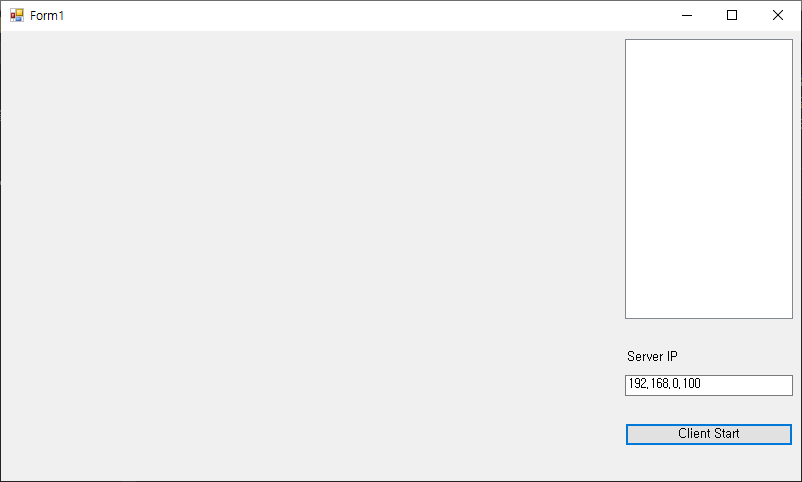
클라이언트를 실행하고 서버 IP주소를 입력한다.


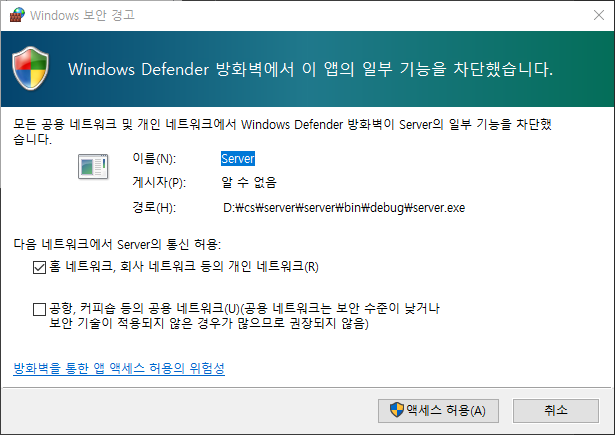
서버의 'Start Server' 버튼을 클릭하면 보안 경고가 나타난다. '액세스 허용' 버튼을 클릭한다.


클라이언트의 'Start Client' 버튼을 클릭한다.


서버 프로그램에는 접속된 클라이언트의 화면과 함께 클라이언트 IP주소, 전송될 데이터 사이즈, 실제 전송된 데이터 사이즈가 표시된다.

같은 컴퓨터에서 서버와 클라이언트를 동시에 실행했기 때문에 같은 IP주소가 표시된다.


클라이언트 프로그램에는 캡쳐한 화면과 함께 접속한 서버의 IP주소, 전송된 데이터 사이즈가 표시된다.


※ 참고

2021.12.24 - [C#] - C# TCP/IP Image transfer - 이미지(파일) 전송 2

2021.12.25 - [C#] - C# TCP/IP Image transfer - 이미지(파일) 전송 3


반응형
Posted by J-sean
:
반응형

Screen capture with Windows API and OpenCV.


1
2
3
4
5
6
7
8
9
10
11
12
13
14
15
16
17
18
19
20
21
22
23
24
25
26
27
28
29
30
31
32
33
34
35
36
37
38
39
40
41
42
43
44
45
46
47
48
49
50
51
52
53
54
55
56
57
58
59
60
61
62
63
64
65
66
67
68
69
70
71
72
73
74
75
76
77
78
79
80
81
82
83
84
85
86
87
88
89
90
91
92
93
94
95
#include <Windows.h>
#include <iostream>
#include "opencv2/imgproc.hpp"
#include "opencv2/highgui.hpp"
 
using namespace std;
using namespace cv;
 
class hWnd2Mat
{
public:
    hWnd2Mat(HWND hWindow, float scale = 1);
    virtual ~hWnd2Mat();
    virtual void Read();
    Mat capture;
 
private:
    HWND hWnd;
    HDC hWindowDC, hWindowCompatibleDC;
    int height, width, srcHeight, srcWidth;
    HBITMAP hBitmap;
    BITMAPINFOHEADER bi;
};
 
hWnd2Mat::hWnd2Mat(HWND hWindow, float scale)
{
    hWnd = hWindow;
    hWindowDC = GetDC(hWnd);
    hWindowCompatibleDC = CreateCompatibleDC(hWindowDC);
    SetStretchBltMode(hWindowCompatibleDC, COLORONCOLOR);
 
    RECT windowsize;    // get the height and width of the screen
    GetClientRect(hWnd, &windowsize);
 
    srcHeight = windowsize.bottom;
    srcWidth = windowsize.right;
    height = (int)(windowsize.bottom * scale);
    width = (int)(windowsize.right * scale);
 
    capture.create(height, width, CV_8UC4);
 
    // create a bitmap
    hBitmap = CreateCompatibleBitmap(hWindowDC, width, height);
    bi.biSize = sizeof(BITMAPINFOHEADER);    // http://msdn.microsoft.com/en-us/library/windows/window/dd183402%28v=vs.85%29.aspx
    bi.biWidth = width;
    bi.biHeight = -height;  //this is the line that makes it draw upside down or not
    bi.biPlanes = 1;
    bi.biBitCount = 32;
    bi.biCompression = BI_RGB;
    bi.biSizeImage = 0;
    bi.biXPelsPerMeter = 0;
    bi.biYPelsPerMeter = 0;
    bi.biClrUsed = 0;
    bi.biClrImportant = 0;
 
    // use the previously created device context with the bitmap
    SelectObject(hWindowCompatibleDC, hBitmap);
};
 
void hWnd2Mat::Read()
{
    // copy from the window device context to the bitmap device context
    StretchBlt(hWindowCompatibleDC, 00, width, height, hWindowDC, 00, srcWidth, srcHeight, SRCCOPY);
    //change SRCCOPY to NOTSRCCOPY for wacky colors!
    GetDIBits(hWindowCompatibleDC, hBitmap, 0, height, capture.data, (BITMAPINFO*)&bi, DIB_RGB_COLORS);
    //copy from hWindowCompatibleDC to hBitmap
};
 
hWnd2Mat::~hWnd2Mat()
{
    DeleteObject(hBitmap);
    DeleteDC(hWindowCompatibleDC);
    ReleaseDC(hWnd, hWindowDC);
};
 
int main()
{
    HWND hWndDesktop = GetDesktopWindow();
    hWnd2Mat desktop(hWndDesktop, 1);    // scale = 1
 
    cout << "Screen capure in 3 seconds." << endl;
    
    for (int i = 3; i > 0; i--)
    {
        cout << i << ".." << endl;
        Sleep(1000);
    }
 
    desktop.Read();
    imshow("Capture", desktop.capture);
 
    waitKey();
 
    return 0;
}


It captures your desktop image in 3 seconds.


반응형
Posted by J-sean
:
반응형

GDI+ Bitmap class inherits from the Image class. The Image class provides methods for loading and saving vector images (metafiles) and raster images (bitmaps). You can build Windows applications with GDI+ and OpenCV.


1
2
3
4
5
6
7
8
9
10
11
12
13
14
15
16
#include <windows.h>
#include <gdiplus.h>
#include <opencv2/opencv.hpp>
 
#pragma comment(lib, "gdiplus")
 
using namespace cv;
using namespace Gdiplus;
 
LRESULT CALLBACK WndProc(HWND, UINT, WPARAM, LPARAM);
HINSTANCE g_hInst;
LPCSTR lpszClass = "MatToBitmap";
 
Mat src;    // source image
Mat org;    // original image
Mat dst;    // processed image
 

Prepare necessities.


1
2
3
4
5
6
7
8
9
10
11
12
13
14
15
16
17
18
19
20
21
22
23
24
25
26
27
28
29
30
31
32
33
34
35
36
37
38
39
40
int APIENTRY WinMain(HINSTANCE hInstance, HINSTANCE hPrevInstance, LPSTR lpszCmdParam, int nCmdShow)
{
    HWND hWnd;
    MSG Message;
    WNDCLASS WndClass;
    g_hInst = hInstance;
 
    ULONG_PTR gpToken;
    GdiplusStartupInput gpsi;
    if (GdiplusStartup(&gpToken, &gpsi, NULL!= Ok) {
        MessageBox(NULL, TEXT("GDI+ start-up error."), TEXT("GDI+ Error"), MB_OK);
 
        return 0;
    }
 
    WndClass.cbClsExtra = 0;
    WndClass.cbWndExtra = 0;
    WndClass.hbrBackground = (HBRUSH)(COLOR_BTNFACE + 1); //(HBRUSH)GetStockObject(WHITE_BRUSH);
    WndClass.hCursor = LoadCursor(NULL, IDC_ARROW);
    WndClass.hIcon = LoadIcon(NULL, IDI_APPLICATION);
    WndClass.hInstance = hInstance;
    WndClass.lpfnWndProc = (WNDPROC)WndProc;
    WndClass.lpszClassName = lpszClass;
    WndClass.lpszMenuName = NULL;
    WndClass.style = CS_HREDRAW | CS_VREDRAW;
    RegisterClass(&WndClass);
 
    hWnd = CreateWindow(lpszClass, lpszClass, WS_OVERLAPPEDWINDOW,CW_USEDEFAULT, CW_USEDEFAULT,
        670340NULL, (HMENU)NULL, hInstance, NULL);
    ShowWindow(hWnd, nCmdShow);
 
    while (GetMessage(&Message, 000)) {
        TranslateMessage(&Message);
        DispatchMessage(&Message);
    }
 
    GdiplusShutdown(gpToken);
 
    return (int)Message.wParam;
}


Start GDI+ and change the background color to the radio button color and Window size.


1
2
3
4
5
6
7
8
9
10
11
12
13
14
15
16
17
18
19
20
21
bool getFile(PTCHAR filename)
{
    OPENFILENAME ofn;
    memset(&ofn, 0sizeof(OPENFILENAME));
    ofn.lStructSize = sizeof(OPENFILENAME);
    ofn.hwndOwner = NULL;
    ofn.lpstrFilter = TEXT("all(*.*)\0*.*\0jpg(*.jpg)\0*.jpg\0png(*.png)\0*.png\0bmp(*.bmp)\0*.bmp\0");
    ofn.lpstrFile = filename;
    ofn.nMaxFile = MAX_PATH;
 
    if (GetOpenFileName(&ofn) != 0) {
        //MessageBox(NULL, filename, TEXT("File opened."), MB_OK);
 
        return true;
    }
    else {
        MessageBox(NULL, TEXT("File open failed"), TEXT("No file selected"), MB_OK);
 
        return false;
    }
}


Retrieve an image file name.


1
2
3
4
5
6
7
8
9
10
11
12
13
14
15
16
17
18
bool ImageLoad()
{
    TCHAR filename[MAX_PATH] = "";
 
    if (getFile(filename)) {
        src = imread(filename);
        if (src.empty()) {
            MessageBox(NULL, TEXT("Image load failed"), TEXT("No image loaded"), MB_OK);
 
            return false;
        }
 
        return true;
    }
    else {
        return false;
    }
}


Read the image from the file.


1
2
3
4
5
6
7
8
void ImageResize()
{
    // maximum image display size: 320 X 240 with original ratio
    double ratio = min((double)320 / (double)src.size().width, (double)240 / (double)src.size().height);
    resize(src, src, cv::Size(), ratio, ratio);
    org = src.clone();
    cvtColor(org, org, COLOR_BGR2BGRA);
}


Resize an image.


1
2
3
4
5
6
7
8
9
10
11
12
13
14
15
16
17
18
19
20
21
22
23
24
25
26
27
28
29
30
31
32
33
34
35
36
37
38
39
40
41
42
43
44
45
46
47
void ImageProcess(int direction)
{
    cvtColor(src, dst, COLOR_BGR2GRAY);
 
    float vertical[] = {
        -202,
        -202,
        -202
    };
 
    float horizontal[] = {
        -2-2-2,
        000,
        222
    };
 
    float diagonal[] = {
        -2-20,
        -202,
        022
    };
    
    Mat emboss;
    switch (direction)
    {
    case 0:
        emboss = Mat(33, CV_32FC1, vertical);
 
        break;
 
    case 1:
        emboss = Mat(33, CV_32FC1, horizontal);
 
        break;
 
    case 2:
        emboss = Mat(33, CV_32FC1, diagonal);
 
        break;
 
    default:
        emboss = Mat(33, CV_32FC1, vertical);
    }
    filter2D(dst, dst, -1, emboss, cv::Point(-1-1), 128);
    
    cvtColor(dst, dst, COLOR_GRAY2BGRA);
}


Process an image with embossing filter.


1
2
3
4
5
6
7
8
9
10
11
12
13
14
15
16
17
18
19
void OnPaint(HDC hdc)
{
    if (!dst.empty()) {
        Graphics G(hdc);
 
        Bitmap bitmapDst(dst.size().width, dst.size().height, dst.step, PixelFormat32bppARGB, dst.data);
        Bitmap bitmapOrg(org.size().width, org.size().height, org.step, PixelFormat32bppARGB, org.data);
        // stride(src.step): Integer that specifies the byte offset between the beginning of one scan line and
        // the next. This is usually(but not necessarily) the number of bytes in the pixel format(for example,
        // 2 for 16 bits per pixel) multiplied by the width of the bitmap. The value passed to this parameter
        // must be a multiple of four.
 
        G.DrawImage(&bitmapDst, 00, bitmapDst.GetWidth(), bitmapDst.GetHeight());
        G.DrawImage(&bitmapOrg, bitmapOrg.GetWidth() + 100, bitmapOrg.GetWidth(), bitmapOrg.GetHeight());
    }
    else {
        TextOut(hdc, 270110, TEXT("No image to display"), 19);
    }
}


Draw original and processed images.


1
2
3
4
5
6
7
8
9
10
11
12
13
14
15
16
17
18
19
20
21
22
23
24
25
26
27
28
29
30
31
32
33
34
35
36
37
38
39
40
41
42
43
44
45
46
47
48
49
50
51
52
53
54
55
56
57
58
59
60
61
62
63
64
65
66
67
68
69
70
71
enum { ID_R1 = 101, ID_R2, ID_R3 };
HWND r1, r2, r3;
int x = 10;
int y = 270;
int w = 90;
int h = 20;
 
LRESULT CALLBACK WndProc(HWND hWnd, UINT iMessage, WPARAM wParam, LPARAM lParam)
{
    HDC hdc;
    PAINTSTRUCT ps;    
 
    switch (iMessage) {
    case WM_CREATE:
        if (ImageLoad()) {
            ImageResize();
            ImageProcess(0);
        }
        
        CreateWindow(TEXT("button"), TEXT("Filter type"), WS_CHILD | WS_VISIBLE |
            BS_GROUPBOX, 525029050, hWnd, (HMENU)0, g_hInst, NULL);
 
        r1 = CreateWindow(TEXT("button"), TEXT("Vertical"), WS_CHILD | WS_VISIBLE |
            BS_AUTORADIOBUTTON | WS_GROUP, x, y, w, h, hWnd, (HMENU)ID_R1, g_hInst, NULL);
 
        r2 = CreateWindow(TEXT("button"), TEXT("Horizontal"), WS_CHILD | WS_VISIBLE |
            BS_AUTORADIOBUTTON, x + 90, y, w, h, hWnd, (HMENU)ID_R2, g_hInst, NULL);
 
        r3 = CreateWindow(TEXT("button"), TEXT("Diagonal"), WS_CHILD | WS_VISIBLE |
            BS_AUTORADIOBUTTON, x + 180, y, w, h, hWnd, (HMENU)ID_R3, g_hInst, NULL);
 
        CheckRadioButton(hWnd, ID_R1, ID_R3, ID_R1);
 
        return 0;
 
    case WM_COMMAND:
        if (!dst.empty()) {
            switch (LOWORD(wParam)) {
            case ID_R1:
                ImageProcess(0);
                break;
 
            case ID_R2:
                ImageProcess(1);
                break;
 
            case ID_R3:
                ImageProcess(2);
                break;
            }
 
            InvalidateRect(hWnd, NULL, TRUE);
        }
 
        return 0;
 
    case WM_PAINT:
        hdc = BeginPaint(hWnd, &ps);
        OnPaint(hdc);
        EndPaint(hWnd, &ps);
 
        return 0;
 
    case WM_DESTROY:
        PostQuitMessage(0);
 
        return 0;
    }
 
    return(DefWindowProc(hWnd, iMessage, wParam, lParam));
}


Define the necessary variables and handle window messages.


Run the application and select an image file.


Processed and original image with a vertical filter.


Processed and original image with a horizontal filter.


Processed and original image with a diagonal filter.


반응형
Posted by J-sean
: